


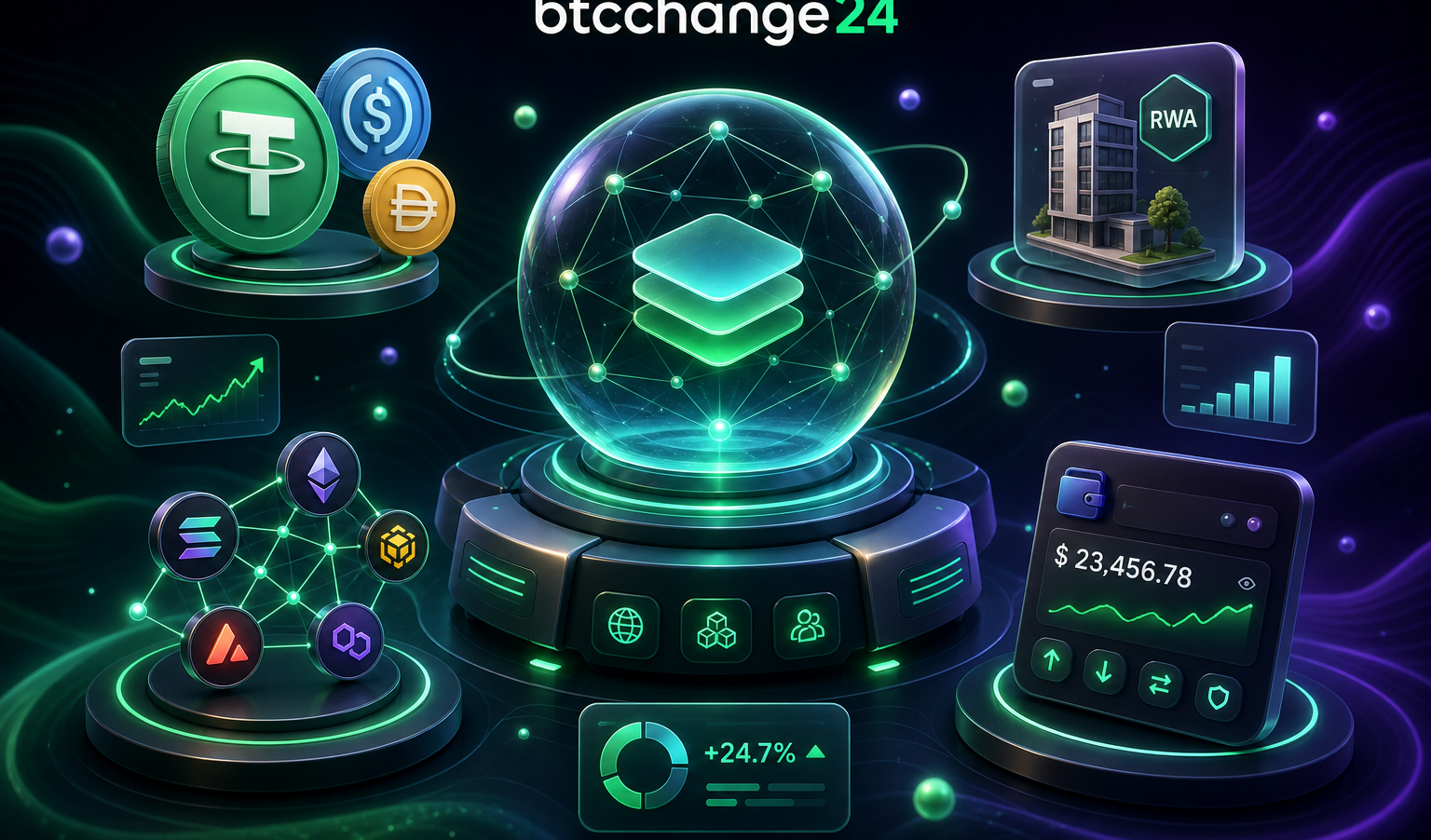
In 2026, Web3 no longer looks like one broad promise of a “new internet.” The ecosystem has split into several practical tracks: stablecoin payments, real-world asset tokenization, infrastructure for multiple networks, wallets with clearer UX, DePIN, AI agents, and regulated products for institutional participants. Some of these ideas are already used in real workflows, some are still experimental, and some require extra caution because of legal, technical, and user-level limitations.
From hype to practical infrastructure
The main Web3 trend is maturity. The market is spending less time valuing projects only by loud token narratives and more time asking whether a product solves a real problem: does it move money faster, reduce operating costs, provide transparent access to assets, or make digital ownership easier to store and transfer?
That does not mean speculation has disappeared. It is still visible, especially around new tokens, memecoins, and AI-related narratives. But durable interest is shifting toward infrastructure: layer-2 networks, cross-chain bridges, custody solutions, wallets, payment rails, and products that make more sense from a regulatory standpoint.
Practical takeaway. For a user in 2026, the key question is not “which Web3 project should I enter?” but which use case they actually need to solve: payments, storage, investment access, DeFi participation, NFTs, gaming, social identity, or business integration.
Stablecoins are becoming a working payment layer
Stablecoins remain one of the most practical parts of Web3. They are used for peer-to-peer settlements, cross-border transfers, internal payments inside crypto services, and as a temporary parking asset between trades. Unlike volatile coins, stablecoins provide a clearer unit of account, although they do not remove issuer, network, or regulatory risks.
One of the biggest changes is stricter oversight of issuers and service providers. In the EU, MiCA has become part of the operating reality for crypto-assets and crypto-asset service providers, and stablecoins are under special scrutiny because of reserve management, licensing, and user protection. That makes the market more formal, but not always simpler for an ordinary user.
Trend limitation. A stablecoin is not the same thing as a bank deposit. You still need to understand who issued it, which network it runs on, whether the target platform supports it, and what risks appear if an address is frozen, the wrong network is chosen, or the infrastructure fails.
Real-world asset tokenization is a strong idea with slow adoption
RWA, or real-world asset tokenization, is one of the most discussed Web3 trends. It refers to tokens linked to bonds, money market funds, real estate, commodities, or other rights. For institutional participants, this can be a way to record ownership more efficiently, automate settlements, and make assets more programmable.
But for a mass-market user, the boundary matters: a token by itself does not guarantee ownership, liquidity, or protection. Everything depends on the legal structure, issuer, custodian, jurisdiction, and transfer rules. That is why tokenization tends to develop where the legal framework is strong, not just where the smart contract looks impressive.
Multichain and modular infrastructure
Web3 is no longer built around a single network. Users now operate across Ethereum, L2s, Solana, the Bitcoin ecosystem, EVM-compatible chains, and specialized blockchains. At the same time, modular architectures are expanding, with separate layers for execution, data availability, finality, and security.
For users, that creates more choice but also a higher chance of mistakes. The same token may exist on different networks, addresses may look similar, and the fee level, speed, and platform support can vary sharply. In practice, Web3 is becoming more dependent on interface quality: a wallet must explain the network, the asset, the fee, and the consequences of an action.
Trend |
What is already being used |
Main limitation |
|---|---|---|
Stablecoins |
Payments, transfers, and settlements inside crypto services |
Issuer, network, regulatory, and address-freeze risks |
RWA |
Institutional tokenization of funds and debt instruments |
Needs a real legal structure, not just a token |
Account abstraction |
Smart wallets, account recovery, and gas sponsorship |
Implementation complexity and wallet-logic trust risks |
DePIN |
Storage, connectivity, sensor, and distributed resource networks |
Hard to prove durable demand and sustainable token economics |
AI + Web3 |
Operation automation, wallet-enabled agents, and onchain payments |
Security, permission control, and accountability |
Wallets are getting closer to ordinary apps
One of Web3’s biggest long-term problems has been wallet complexity. Seed phrases, manual network selection, native-token gas fees, opaque transaction signatures, and irreversible mistakes all slowed broader adoption. That is why account abstraction and smart wallets have become such an important direction.
Ethereum documentation describes account abstraction as a way to add flexible security rules, account recovery, third-party gas payments, and bundling of several actions into a single operation. For a user, this may look like passkey login, transaction limits, trusted devices, and clearer confirmations.
But this matters. Better UX should not hide risk. If a wallet can sign more complex actions for a user, that user still needs to understand what permissions are being granted and whether access can be revoked later.
DePIN and physical infrastructure
DePIN tries to connect blockchain systems with the real world: data storage, wireless networks, computing, maps, sensors, and energy systems. The idea is that participants receive tokens for contributing a useful resource, while the network grows through distributed incentives rather than a single centralized operator.
The direction has potential, but the market has become stricter. It is not enough to hand out tokens for activity. A project has to show that there is outside demand for the resource, that the economics are not supported only by token issuance, and that the service quality is comparable to traditional alternatives.
AI agents and Web3 look promising, but it is too early for blind trust
The AI + Web3 combination has become one of the loudest narratives in the market. People discuss agents that can hold a wallet, pay for services, execute onchain actions, participate in data markets, and automate financial workflows. The logic is clear: blockchain provides programmable settlement, while AI provides a decision layer and interface.
But this is also where expectations often run ahead of reality. An agent with access to funds needs strict limits, action logs, isolated permissions, and a clear override mechanism. Without that, convenience turns into a new class of operational mistakes, because the user may not fully understand what has been automated.
Regulation is becoming part of the product
In 2026, regulation can no longer be treated as outside noise. For exchanges, payment services, custodians, stablecoin issuers, and tokenized-asset providers, the legal model is now part of product competitiveness. For users, this matters almost as much as the interface, because the rules shape service availability, verification requirements, jurisdictional limits, and the way assets are handled.
At the same time, regulation does not make Web3 fully safe. It reduces some infrastructure and operational risks, but it does not remove volatility, user mistakes, smart-contract vulnerabilities, or fraud.
Answers to common questions
Which Web3 trends are the most practical for an ordinary user?
The most practical directions are stablecoins for payments, more convenient wallets, low-fee L2 networks, and services that hide part of the multichain complexity. RWA, DePIN, and AI agents still require a better understanding of risk before they become mainstream user tools.
Should Web3 already be considered a mass-market technology?
Partly. Some Web3 elements are already used at scale, especially for payments, asset storage, and exchange infrastructure. But many use cases are still too complex for beginners and depend heavily on wallet quality, regulation, and security.
Why does multichain increase the chance of mistakes?
Because the same asset can exist on several networks, while a service may support only some of them. If a user sends a token through an unsupported network or to the wrong address format, recovery may be difficult or impossible.
Are AI agents in crypto already safe enough for broad use?
They should still be approached carefully. Without limits, clear permissions, and action-level controls, an agent with wallet access can create a serious risk. For now, this is more of a promising direction than a mature universal standard.
Conclusion
The modern Web3 ecosystem is not moving as one unified revolution. It is developing as a set of practical layers with different speeds, strengths, and risks. Stablecoins, tokenization, new wallet models, multichain infrastructure, DePIN, and AI agents all matter, but not in the same way. The best approach for a user in 2026 is to ignore the broad hype and test the exact scenario instead: who stands behind the asset, which network it uses, where the fees appear, what rights the token actually gives, and what happens if something goes wrong.
