


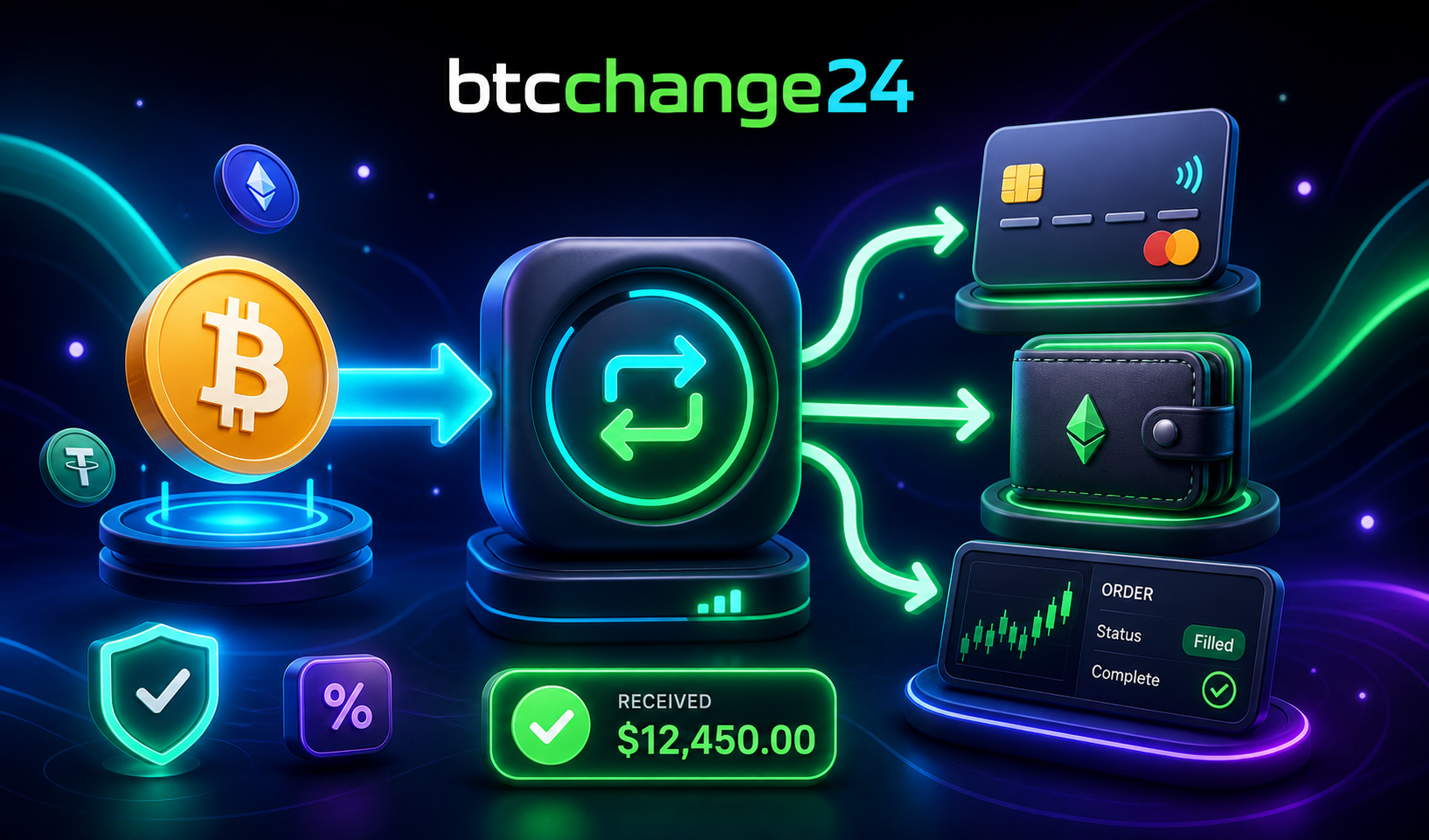
Withdrawing money from cryptocurrency is not just a matter of pressing “send”. The real risk sits in the route: whether you use a card payout, a personal wallet, an exchange deposit, or a P2P transaction. Before sending funds, you need to verify the asset, network, recipient details, final amount, request status, and the way the platform confirms completion. BTCChange24 may be considered as one possible exchange route, but any operation still requires checking the current direction, payment details, request terms, and final amount before you transfer funds.
Start with the exact asset and network
The first practical rule is simple: do not think in generic terms such as “crypto”. Think in exact terms: BTC on the Bitcoin network, ETH on Ethereum, USDT on TRC20, USDT on ERC20, or another supported network. The same ticker can exist on different blockchains, and the receiving platform may support only some of them.
Common mistake. A user sees “USDT” and assumes any USDT transfer will work. In reality, sending USDT through an unsupported network can lead to a failed credit, a manual recovery process, or a permanent loss depending on the receiving platform’s rules and technical ability.
Card, wallet, or exchange: what changes
A card route is usually chosen when the final goal is fiat money. A wallet route is useful when the user wants to keep control of crypto, move funds to another owner, or prepare for a later transaction. An exchange route makes sense when the user wants order-book trading, conversion between assets, or a regulated account workflow.
No route is automatically the safest or the cheapest. Card withdrawals add payment and banking checks. Wallet transfers require strong address discipline. Exchange deposits may require KYC, account limits, memo or tag fields, and internal monitoring rules.
Withdrawal route |
What to check |
Main risk |
Safer action |
|---|---|---|---|
Card payout through an exchange service |
Direction, recipient details, final amount, request status, and payment rules |
Wrong payment details, changed terms, or delayed bank credit |
Use only current request details, confirm the final amount, and keep the request ID |
Personal crypto wallet |
Address, network, token support, and network fee |
Sending to an unsupported network or wrong address |
Use a test transfer for large amounts and verify the first and last address characters |
Crypto exchange deposit |
Deposit network, memo/tag, account status, limits, and KYC requirements |
Deposit may be delayed or not credited if the memo or network is wrong |
Copy details from the current deposit page and avoid old saved addresses |
P2P route |
Counterparty rating, platform rules, payment method, and confirmation flow |
Payment dispute, third-party details, or pressure to release funds early |
Stay inside platform rules and release crypto only after confirmed payment |
How to calculate the final amount
The visible exchange rate is only one part of the result. The final amount may also reflect spread, platform fees, withdrawal fees, blockchain network fees, and payment-side costs. For this reason, comparing routes by headline rate alone is unreliable.
Practical approach. Compare the “amount to receive” field after entering the exact asset, network, amount, and payout method. If two routes use different networks or different payout methods, they are not a clean comparison.
Recipient details and transaction data
Crypto transfers are difficult to reverse once broadcast. That is why recipient details should be checked before the transaction, not after a support ticket is opened. Use the current deposit or request page, not an address copied from an old chat, browser history, or previous transaction.
- verify the network label in the request;
- check whether memo, tag, or payment ID is required;
- make sure the amount matches the request if exact payment is required;
- save the transaction hash and request number;
- do not rush under pressure from a counterparty or chat operator.
Request status and blockchain confirmations
A transaction can be visible on-chain and still not credited by a platform. Many platforms wait for a required number of confirmations. Some operations also pass through internal checks. This does not always mean something is wrong, but it means the user should track both the blockchain status and the platform request status.
If support is needed, prepare the asset, network, amount, recipient address, transaction hash, request ID, and time of transfer. Without this information, even a normal review can take longer.
Banking and compliance risks
When the final destination is a bank card or bank account, blockchain risk is not the only issue. A bank or payment provider may review incoming funds, unusual activity, source of funds, or the payment description. No route can guarantee that every bank will process every transfer without questions.
For larger or business-related amounts, keep records: exchange request, transaction hash, invoices, sale history, or other documents explaining the source of funds. This is not legal advice, but it is a practical risk-control habit.
Pre-withdrawal checklist
- Identify the exact asset and network.
- Choose the route: card, wallet, exchange, or P2P.
- Compare the final amount to receive, not only the rate.
- Verify address, payment details, memo/tag, and request amount.
- Save the request number before sending funds.
- Send only after checking current recipient details.
- Track the transaction hash and platform status until completion.
Frequently Asked Questions
Can withdrawal speed be guaranteed in advance?
No. Timing depends on the blockchain, confirmations, platform processing, payment provider, bank checks, and sometimes manual review.
What matters more: the rate or the final amount?
The final amount matters more. A better-looking rate may be offset by spread, network fees, withdrawal fees, or payment-side costs.
Should I make a test transfer first?
For a large amount or a new route, a small test transfer can reduce operational risk. It does not remove fees, but it helps verify the network and recipient details.
What if I sent funds through the wrong network?
Collect the transaction hash, network, address, and amount, then contact the receiving platform. Recovery is not guaranteed and depends on technical and policy limits.
Conclusion
A safe crypto withdrawal is built on verification, not on speed assumptions. Confirm the asset and network, compare the final amount, check recipient details, save the request data, and only then send the transaction. The fewer assumptions you make, the lower the risk of losing funds to a preventable route or address mistake.
