


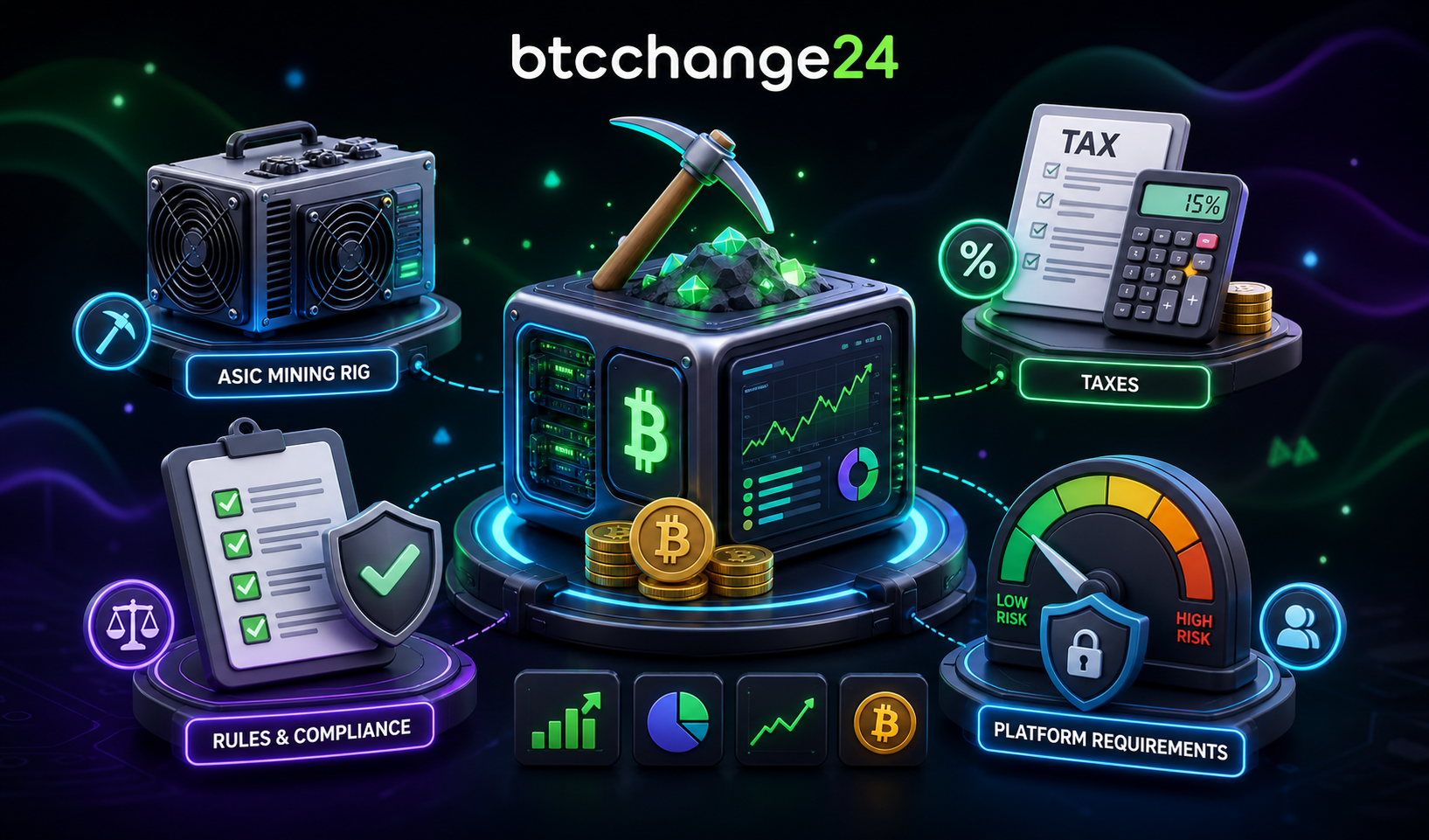
Choosing cryptocurrency mining is not just about finding the coin that looks profitable today. A serious approach starts with hardware economics, electricity cost, legal power supply, tax records, and the rules of the platforms where mined coins will be stored or sold. In 2026, mining is less of a hobby experiment and more of a regulated technical business with compliance risks.
What exactly are you choosing?
Beginners often start with the coin, but the first decision is the operating model: your own mining farm, hosted equipment, cloud mining, or participation in a pool. Each model distributes costs, control, and legal duties differently. A private farm gives more control but requires space, power, cooling, and maintenance. Hosting reduces infrastructure tasks but creates dependence on the facility operator.
Model | Advantages | Risks |
|---|---|---|
Own farm | Control over equipment and wallets | Power supply, noise, cooling, safety, business registration |
Hosted equipment | Facility handles infrastructure | Contract terms, equipment access, tariff changes, downtime |
Cloud mining | No hardware maintenance | Opaque economics and provider risk |
Mining pool | More predictable reward distribution | Pool fees, payout rules, operator dependence |
Economics: profitability calculators are not enough
Mining calculators are useful, but they reflect current inputs. Real economics depend on network difficulty, coin price, electricity, downtime, repairs, ventilation, internet, and hardware depreciation. If equipment is financed or bought with business working capital, the cost of capital also matters.
Common mistake. Calculating payback using today’s revenue while ignoring price drops, difficulty growth, downtime, repairs, or resale value of equipment.
Electricity and hosting site
Mining consumes significant electricity, so the power source must be legal and technically stable. Informal connections, household tariffs for industrial load, or overloaded wiring create risks of shutdowns, penalties, and equipment damage. If the equipment is placed at a third-party facility, the contract should define the tariff, downtime responsibility, access, repair procedure, and removal conditions.
Practical example. A low electricity price is not useful if the facility cannot provide stable power, cooling, and clear access to the machines.
Taxes and income records
The tax treatment depends on the country, miner status, business form, and how the mined coins are sold. Some jurisdictions may require business registration; others focus on income declaration when crypto is sold. There is no universal tax answer for every user, so local rules must be checked.
In practice, miners should keep records: mining dates, coin amounts, wallet addresses, electricity costs, hardware purchases, repairs, hosting fees, pool fees, and sale dates. Without records, it is harder to explain source of funds and calculate financial results.
Pool, exchange, and exchanger requirements
Mined coins usually pass through a wallet, pool, or exchange. Each platform has rules: minimum payouts, fees, supported networks, KYC, regional restrictions, and source-of-funds checks. If mined crypto is later sold through an exchange or exchanger, the service may ask for documentation.
Practical insight. Documentation is not just bureaucracy for a miner. It protects future liquidity. The clearer the origin of coins, the fewer problems may arise when selling them.
Regulation and compliance
Many countries are increasing oversight of mining: registries, facility requirements, electricity control, and tax reporting. AML checks are also becoming more common when funds move through exchanges and exchangers. Planning mining as “invisible income” is therefore risky.
- Check whether mining is allowed in your jurisdiction and region.
- Clarify registration, reporting, and tax obligations.
- Avoid grey electricity connections.
- Keep contracts, invoices, receipts, and pool payout history.
How to decide without self-deception
Before buying equipment, build a conservative model: revenue below the current level, electricity with a safety margin, downtime and repairs included, taxes considered, and payback not dependent on a perfect market. If the project still works under conservative assumptions, it deserves deeper analysis.
Mined crypto can later be sold through exchanges, P2P, or exchange services. In that context, BTCChange24 may be one possible exchange channel, but actual direction conditions should be checked at the time of the order.
Documents and operational discipline
Even a small mining project quickly creates many records: hardware invoices, repair documents, hosting contracts, pool payouts, wallet transfers, and crypto-to-fiat exchanges. If these records are scattered across chats and emails, reconstructing the picture later becomes difficult. A separate spreadsheet or accounting system should be started from day one.
The record should include not only revenue but also expenses. Electricity, delivery, customs duties, cables, power supplies, ventilation, pool fees, and downtime all affect the real result. A project that seems to “pay back in one year” may look much weaker after full accounting.
Operational discipline also matters for security. Pool accounts, wallets, and hosting dashboards should be protected with two-factor authentication. Seed phrases and private keys should not be stored in a team chat. If mining is run as a business, access rights for changing payout addresses and withdrawing funds must be defined in advance.
Frequently Asked Questions
Do I need to register mining as a business?
It depends on the country, scale, user status, and local rules. For regular income and industrial power consumption, professional tax advice is strongly recommended.
Can I mine at home?
Sometimes it is technically possible, but household wiring, heat, noise, fire safety, and tariffs often make home mining risky or economically weak.
Is the electricity tariff more important than the contract?
Both matter. A low tariff without clear access, downtime rules, and responsibility may be worse than a more expensive but transparent hosting site.
Conclusion
Mining should be approached as an investment and operational project, not as a simple “money machine”. Start with economics, electricity, hosting, taxes, and platform rules; only then choose hardware and coins. This order reduces mistakes and shows whether the project is truly sustainable.
