


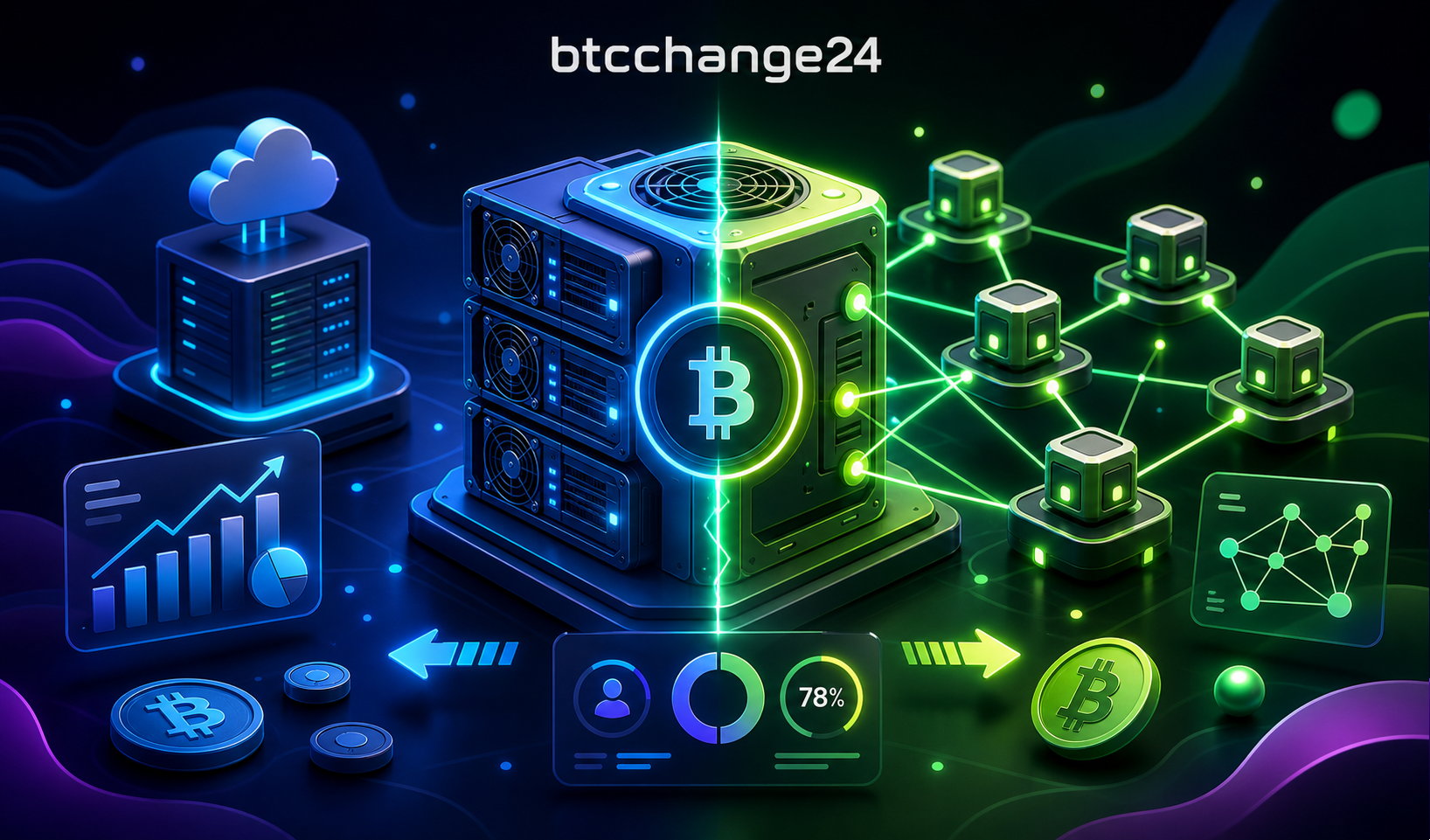
Cryptocurrency mining is not simply a computer “printing coins.” In Proof-of-Work networks, miners perform computations, help confirm blocks of transactions, and support network security. But the practical participation models are very different: home mining, industrial farms, hosting, cloud contracts, pools, and more decentralized setups all provide different levels of control, cost, and risk.
What a miner actually does
A miner searches for a valid solution for a new block. If the block is accepted by the network, transactions are added to the blockchain and the miner or mining pool receives a reward according to the protocol rules. For the user, it looks like hardware running, but behind it are hashrate competition, network difficulty, electricity cost, cooling, maintenance, and market volatility.
Term explained. Hashrate is the computing power directed at finding blocks. The higher the total network hashrate, the harder it is for one small miner to find a block alone.
Hardware, electricity, and infrastructure
Modern mining depends on much more than buying a device. Electricity price, stable power, heat, noise, ventilation, repairs, firmware, downtime, and physical security all matter. A powerful machine can still become unprofitable if energy is expensive or uptime is weak.
Professional miners therefore calculate the whole operating setup: equipment cost, delivery, hosting, pool fees, maintenance, taxes, and the risk that the mined coin falls in price.
Centralized models: farms, hosting, and cloud mining
Centralized models make entry easier. A user may buy a contract, place ASIC hardware with an operator, or use a service that manages power, cooling, and maintenance. This is convenient, but it reduces control. The user depends on the operator’s reporting, downtime policy, fees, and withdrawal rules.
Main risk. The less direct control you have over hardware and payouts, the more important it is to check the operator’s structure, track record, fee transparency, exit terms, and real uptime history.
Decentralized models: own hardware, nodes, and pool choice
A more decentralized approach means the participant owns hardware, configures connectivity, chooses a pool or solo mode, may run a full node, and better understands which transactions and block templates are supported. This requires more technical skill but gives more control.
In practice, even independent miners often use pools because solo mining with a small hashrate can produce extremely irregular results. The real question is not only “pool or no pool,” but how much control remains over payouts, block templates, fees, statistics, and censorship resistance.
Participation model comparison
Model | How it works | What to check | Main risk |
|---|---|---|---|
Home mining | The user buys and runs the hardware directly | Electricity, noise, cooling, networking, profitability, physical safety | High technical and household costs |
Industrial hosting | Hardware is placed with an infrastructure operator | Uptime, tariffs, repairs, access to hardware, contract terms | Dependence on the operator and hidden costs |
Cloud mining | The user buys a contract for computing power | Service reputation, payout model, fees, contract term | Low transparency and fraud risk |
Mining pool | Miners combine hashrate and share rewards by pool rules | Fees, payout method, statistics, latency, block template control | Centralized influence and dependence on pool rules |
Solo / own node | The participant keeps maximum infrastructure control | Hashrate, node stability, network latency, admin skills | Irregular income and high technical complexity |
Profitability without investment promises
Mining profitability cannot be promised in advance. It depends on coin price, network difficulty, block rewards, fees, electricity, downtime, equipment price, and hardware lifetime. A calculation that looks positive today can change after a difficulty increase or market decline.
Practical approach. Calculate several scenarios: base case, stress case, and adverse case. The stress case should include lower coin price, higher difficulty, downtime, and extra repair costs.
Network security and centralization risk
Mining matters not only as a way to earn coins but also as a network security mechanism. The more distributed the hashrate is among independent participants, the harder it is for one party to influence transaction inclusion or network resilience. When a large share of hashrate concentrates in a few pools or operators, centralization becomes a serious discussion.
For an individual participant, pool choice is not only about payouts. It is also about trust, transparency, and influence on the ecosystem.
Frequently Asked Questions
Can I start mining without technical knowledge?
You can use hosting or cloud services, but this increases dependence on an operator. Check contracts, fees, reporting, service history, and exit terms before paying.
What matters more: cheap electricity or powerful hardware?
Both matter. Powerful hardware with expensive electricity or poor uptime may perform worse than a moderate setup with stable infrastructure.
Does a pool make mining centralized?
A pool is not automatically bad, but concentration of hashrate in a few pools reduces distribution. Check rules, fees, payout transparency, and control over block templates.
Is mining passive income?
Not really. Even with hosting, there are risks related to price, difficulty, equipment, operator performance, downtime, and payout terms. It is operational activity with market risk.
Conclusion
Cryptocurrency mining combines computation, infrastructure, economics, and trust in the chosen participation model. Centralized solutions are easier to enter but require operator due diligence. Decentralized setups give more control but demand skills and discipline. The safer approach is to calculate costs honestly, reject income guarantees, and understand exactly where your control begins and ends.
