


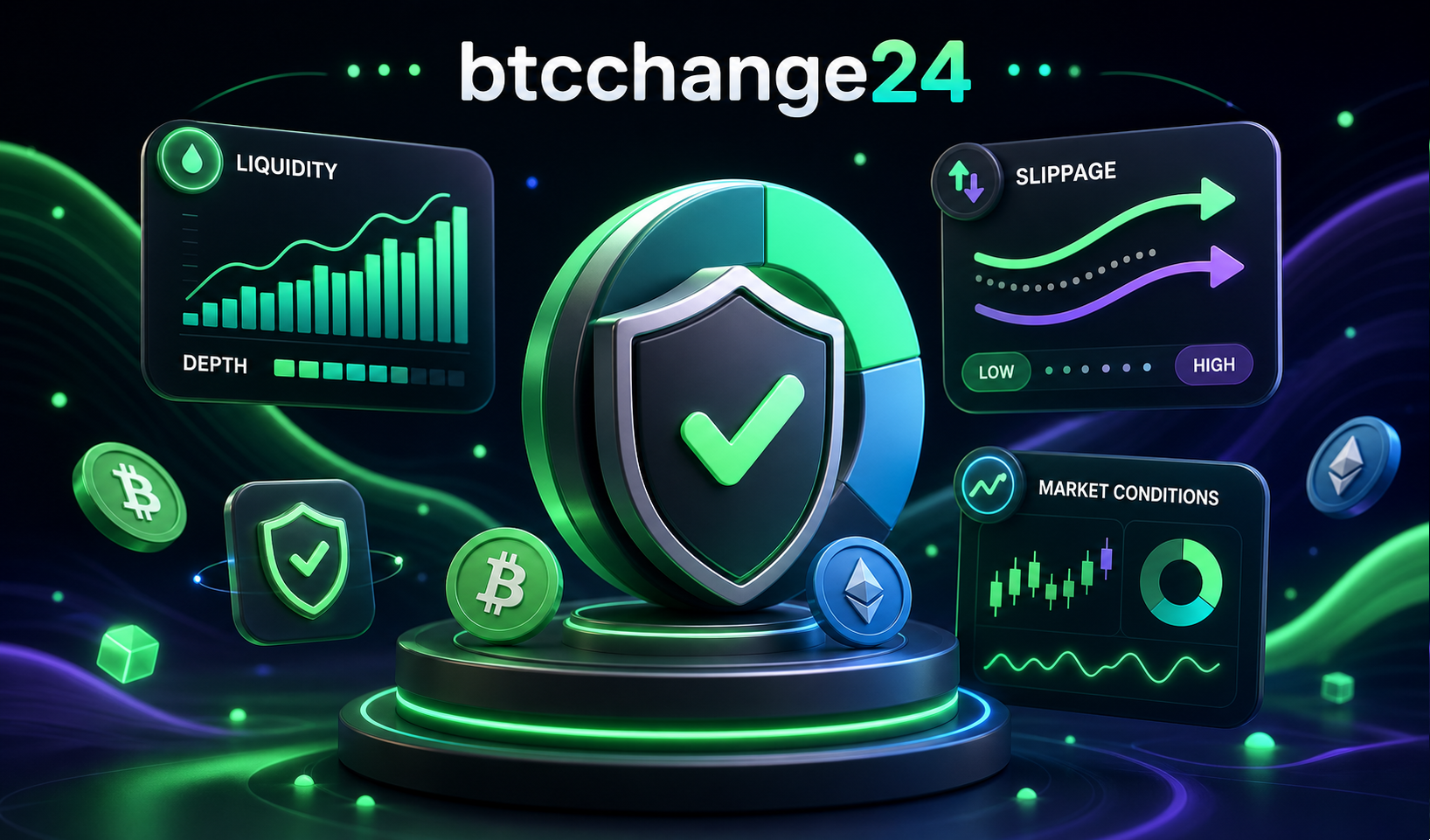
Before a crypto deal, the rate shown on a screen is only the starting point. The real outcome depends on liquidity, order-book depth, market volatility, network speed, and the execution rules of the platform you use. A short pre-check helps avoid poor fills, unrealistic quotes, and timing mistakes that can turn a seemingly good rate into a disappointing result.
Why the displayed price may differ from the final result
Crypto markets are fragmented across exchanges, exchangers, P2P desks, and DeFi pools. Each venue has its own liquidity and execution model. A quote that looks fair for a small amount may not be available for a larger order.
Practical example. Buying a small amount of BTC may execute close to the visible rate. A larger order in a thin market may consume several price levels, so the average execution price becomes worse. That difference is slippage.
Liquidity checks before you commit
Liquidity means how easily an asset can be bought or sold without moving the price too much. Do not look only at general popularity. Check whether there is enough depth for your specific amount and route.
- Is the trading pair active and consistently quoted?
- How wide is the buy/sell spread?
- Is there enough depth near the current price?
- Is the quoted rate temporary or unusually attractive?
- How fast does the quote change while you prepare the deal?
Spread and slippage: where the real cost appears
The spread is the gap between buy and sell prices. Slippage is the difference between the expected and executed price. Both matter most during volatility, in less liquid assets, and when the transaction size is large compared with available liquidity.
Factor | What it means | How to reduce risk |
|---|---|---|
Wide spread | Buying and selling prices are far apart. | Compare routes and avoid low-activity periods. |
Thin depth | Your amount may execute across worse price levels. | Split the transaction or choose a deeper market. |
Fast volatility | The quote changes before confirmation. | Check rate-lock and recalculation rules. |
Market conditions that deserve attention
Look at the broader context: major news, abnormal price candles, network congestion, weekend liquidity, and sudden changes in stablecoin demand. Even a reliable service can execute under difficult conditions if the market is moving quickly.
Common mistake. A user focuses on a good rate but ignores a congested network. Confirmation takes longer, the quote expires, and the final amount is recalculated under worse conditions.
Checking the exchange route
When using an exchange service such as BTCChange24, review the asset, network, receiving amount, address, rate validity, and support procedure before sending funds. Clarify unclear details before payment, not after the transaction has already been broadcast.
- Confirm the asset ticker and blockchain network.
- Review the amount, quote, and recalculation conditions.
- Make sure the route suits your transaction size.
- Copy addresses and payment details carefully.
- Save the order ID and transaction hash.
When it is better to wait
Postpone the deal if the market is moving aggressively, the network is overloaded, the route is unclear, or the amount is too important to test under uncertain conditions. For a new route, a smaller first transaction may be sensible when the service rules allow it.
Frequently asked questions
Can slippage be avoided completely?
Not when execution depends on live markets. You can reduce it by choosing liquid routes, checking rate-lock rules, avoiding thin markets, and not rushing during volatility.
Why do platforms show different rates?
They use different liquidity sources, reserves, fees, and execution models. Compare the final amount you receive, not only the headline rate.
Is the fee more important than the spread?
The total result matters. A low visible fee can be offset by a wide spread, while a clearer rate may be better after all costs are included.
Conclusion
A careful crypto deal starts before funds are sent. Check liquidity, spread, order size, market context, network choice, and recalculation rules. This does not guarantee the perfect price, but it greatly reduces avoidable execution mistakes.
